

data science

Events

images/02_events/DASHH.jpg#joomlaImage://local-images/02_events/DASHH.jpg?width=800&height=300
Thursday, April 04th, 2024 | 17:00 p.m

Data Science Colloquium: Neural Approaches to Optimal Transport

via Zoom

Prof. Marco Cuturi, Professor of Statistics, CREST - ENSAE, Institut Polytechnique de Paris
Research Scientist, Apple ML Research, Paris

In his talk, Prof. Cuturi wil cover the basics of the Kantorovich and Monge optimal transportation problems. In the following, he will proceed with an exposition of various approaches recently proposed to estimate optimal transport maps at scale, using samples from two probability distributions and neural networks.

images/02_events/DSS.png#joomlaImage://local-images/02_events/DSS.png?width=800&height=300
Wednesday, September 3th - 4th, 2025 | 12:00 - 17:30 a.m.

10th Data Science Symposium 2025

on-site in Geesthacht

Building bridges between methods, applications and infrastructure

The 10th Data Science Symposium (DSS) will take place on-site in Geesthacht, on September 3-4, 2025. This time it is organized by Hereon and the Helmholtz Coastal Data Center (HCDC).

Established in 2017, this is part of a joint series of symposia of AWI, GEOMAR and Hereon. It aims at building bridges between science methods, science applications, and infrastructure developments.

The following collection of topics outline the focus areas of the 10th DSS:

  • Artificial Intelligence/ Machine Learning methods in Earth System Sciences
  • Foundation Models & LLMs
  • HPC for Data Science
  • Digital Twins
  • IoT/OGC STA
  • Sensor Management
  • QA/QC
  • Metadata
  • Data Management Workflows
  • Data Exploration Tools
  • Collaborations and Data Initiatives
  • Success Stories out of the history of the 9 previous Data Science Symposia

Registration closes on August 1, 2025, places are limited, register now

Institutions

  • Hereon
  • Helmholtz Coastal Data Center (HCDC)
images/02_events/iccs_2026_logo.jpg#joomlaImage://local-images/02_events/iccs_2026_logo.jpg?width=800&height=300
Monday, June 29th - Wednesday, July 1th, 2026 | 18:00 p.m

26th International Conference on Computational Science: “At the Forefront of Science through Computation and Data”.

DESY, Hamburg, Germany

The International Conference on Computational Science is an annual conference that brings together researchers and scientists from mathematics and computer science as basic computing disciplines, as well as from other various application areas, who are pioneering computational methods in sciences such as physics, chemistry, life sciences, and engineering, as well as in arts and humanitarian fields, to discuss problems and solutions in the area, identify new issues, and shape future directions for research.

ICCS 2026 in Hamburg, Germany will be the twenty-sixth edition in this series of highly successful conferences.

The conference theme for this year is “At the Forefront of Science through Computation and Data”.

This conference will be a unique event focusing on recent developments in: scalable scientific algorithms; advanced software tools; computational grids; advanced numerical methods; and novel application areas. These innovative novel models, algorithms and tools drive new science through efficient application in areas such as physical systems, computational and systems biology, environmental systems, finance, and others.

Institutions

  • DESY
  • The University of Tennessee Knoxville
  • The University of Amsterdam
images/02_events/3D%20Data%20Visualization.png#joomlaImage://local-images/02_events/3D Data Visualization.png?width=800&height=300
Monday, 10th - Thursday, 13th November, 2025 | 09:00 - 18:00 p.m.

3D Data Visualization

online

Join us for an engaging 4-day workshop where you’ll bring your own volumetric datasets to life through 3D visualization. We’ll start with impulse sessions on topics like volumetric rendering, mesh processing, and browser visualization. Then, with support from our experts, you’ll apply these techniques directly to your data. Along the way, you’ll work with tools like Fiji, VTK, Blender, and Neuroglancer, and programming skills will be helpful to get the most out of the experience. The workshop wraps up with a gathering where you’ll share your visualizations and experiences.

Learning goals here

Prerequisites

Participants should apply with a 3D dataset they wish to visualize during the workshop. Please ensure your dataset is publicly accessible and provide a link to it when applying, along with a brief description of its context. Basic programming skills—especially in Python (see “First steps in Python”) — are recommended for engaging with tools and scripting tasks we’ll cover.

Institutions
images/02_events/DRT.jpg#joomlaImage://local-images/02_events/DRT.jpg?width=800&height=300
Thursday, June 26th, 2025 | 18:00 . 19:30 p.m.

4. Roof Talk Digital Health

University of Applied Sciences and Medical University, Am Kaiserkai 1, 20457 Hamburg

Austauschen und Netzwerken - für Gestalter:innen des digitalen Gesundheitswesens

Wie können wir Digitalstrategien im Gesundheitsbereich neu denken? Und welche Chancen und Herausforderungen hält das Thema Digital Health für Gründerinnen und Gründer bereit? Der »Roof Talk Digital Health« bietet zu diesen und ähnlichen Themen eine Plattform zum Austauschen und Netzwerken – für Gestalterinnen und Gestalter des digitalen Gesundheitswesens und alle, die sich für diese an Bedeutung zunehmende Branche interessieren.

Der »Roof Talk Digital Health« findet jährlich am letzten Donnerstag im Juni statt. Über den Dächern Hamburgs mit Blick auf die Elbphilharmonie und den Hafen kommen Unternehmer:innen, Gründer:innen und Entscheider:innen aus Krankenhäusern und Verbänden sowie Forschende und Studierende ins Gespräch. Abgerundet wird das Programm in der Regel mit zwei Kurzvorträgen.

Die Teilnahme ist kostenfrei und für Getränke und Verpflegung während der Veranstaltung ist gesorgt. Um unsere Planung zu vereinfachen bitten wir um formlose Anmeldung bis zum 22. Juni 2025 unter veranstaltung@medicalschool-hamburg.de

Institutions

  • MSH
images/02_events/Bildschirmfoto%202024-01-25%20um%2011.25.09.png#joomlaImage://local-images/02_events/Bildschirmfoto 2024-01-25 um 11.25.09.png?width=840&height=390
Tuesday, March 05th, 2024 | 14:00 p.m.

Al for biomedical imaging: computational superresolution and more - BNITM seminar series "AI in Biology and Medicine".

BNITM, Bernhard-Nocht-Straße 74, 20359 Hamburg

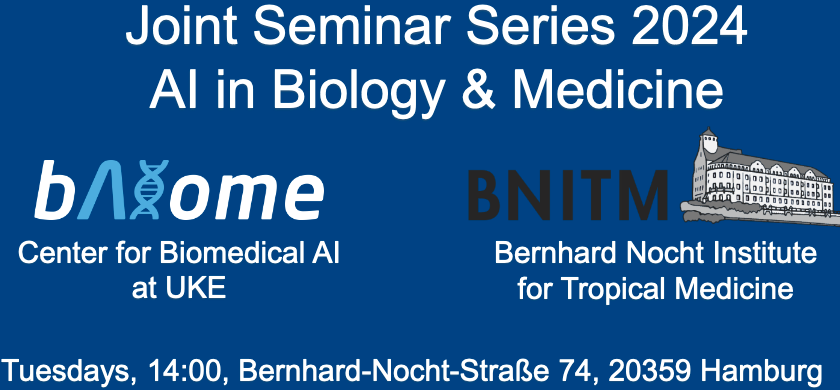
bAIome Center for biomedical AI (UKE) and Bernhard Nocht Institute for Tropical Medicine (BNITM) will host the seminar series entitled “AI in biology and Medicine”. This series aims to capture a broad audience and promote cross institutional collaboration. Our expert speakers will give an overview and insight into particular AI/data science methods being developed in key areas of biology and medicine. We will have drinks and snacks following each seminar to facilitate exchange.

René Werner, Institute for Applied Medical Informatics, UKE

For further details and hybrid links, please go to the webpage AI in Biology & Medicine


images/02_events/_logo-for-kiez2._1.jpg#joomlaImage://local-images/02_events/_logo-for-kiez2._1.jpg?width=1000&height=400
Monday, September 25th, 2023 | 09.00-18.00 & Tuesday 26th, 2023 | 09.00-13.00

Autumn School: Sign language data meets data science – data science meets sign linguistics

Gorch-Fock-Wall 7, 20354 Hamburg
The goal of this Autumn School is to generate expertise for under-resourced sign languages. The workshop is aimed both at data scientists who would like to work with sign languages and at sign language linguists who would like to know more about technical approaches.  On the first day we will run parallel presentation sessions to introduce each group to the subjects which are new to them and the second will have talks on subjects which are relevant to both groups.  There will also be a poster session where participants can present their current work on sign language data in a more informal setting.
 
Workshop languages are English and International Sign

Details and registration information here

Organised by The EU EASIER project in cooperation with the DGS-Korpus project

Institutions
images/02_events/BCCN.jpg#joomlaImage://local-images/02_events/BCCN.jpg?width=800&height=300
Wednesday, January 15th, 2026 | 14:15 - 15:45 p.m.

BCCN Lecture Series: AI Governance in China

online

Jeffrey Ding (George Washington University): Reputation Collectives: How International Industry Associations Influence China's Safety Standards in High-Risk Technologies

Artificial intelligence is rapidly transforming societies, economies, and political systems worldwide, and China is emerging as a central actor in shaping the governance of these technologies. This lecture series explores the multiple dimensions of AI governance in China, from state regulation and the role of AI in public administration to societal engagement with AI technologies.

The lectures highlight how China’s AI ambitions intersect with broader global trends and geopolitical tensions. The rise of generative AI has intensified the U.S.–China technological and strategic competition, introducing new complexities to the traditional security dilemma. At the same time, Chinese efforts to regulate and promote AI domestically reflect broader concerns over economic competitiveness, social stability, and regime security. The BCCN lecture series shed light on how AI is reshaping power relations, technological competition, and everyday life.

Join us online and in person for six lectures featuring leading scholars, including: Jinghan Zeng (City University of Hong Kong), Hui Zhou and Genia Kostka (Freie Universität Berlin) and Angela Huyue Zhang (USC Gould School of Law), Eddie Yang (Purdue University), David Yang (Harvard University) and Jeffrey Ding (George Washington University).

Hosted by the Berlin Contemporary China Network (BCCN), the China Competence Training Center (CCTC) and SCRIPTS, the 2025/26 winter term lecture series is conceptualized by Prof. Dr. Genia Kostka and Anton Bogs from Freie Universität Berlin.

Registration here

Institutions

  • Institut für Asien- und Afrikawissenschaften, Humboldt-Universität zu Berlin 
images/02_events/BCCN.jpg#joomlaImage://local-images/02_events/BCCN.jpg?width=800&height=300
Wednesday, January 22th, 2026 | 14:15 - 15:45 p.m.

BCCN Lecture Series: AI Governance in China

online

David Y. Yang (Harvard University): Government as Venture Capitalists in AI

Artificial intelligence is rapidly transforming societies, economies, and political systems worldwide, and China is emerging as a central actor in shaping the governance of these technologies. This lecture series explores the multiple dimensions of AI governance in China, from state regulation and the role of AI in public administration to societal engagement with AI technologies.

The lectures highlight how China’s AI ambitions intersect with broader global trends and geopolitical tensions. The rise of generative AI has intensified the U.S.–China technological and strategic competition, introducing new complexities to the traditional security dilemma. At the same time, Chinese efforts to regulate and promote AI domestically reflect broader concerns over economic competitiveness, social stability, and regime security. The BCCN lecture series shed light on how AI is reshaping power relations, technological competition, and everyday life.

Join us online and in person for six lectures featuring leading scholars, including: Jinghan Zeng (City University of Hong Kong), Hui Zhou and Genia Kostka (Freie Universität Berlin) and Angela Huyue Zhang (USC Gould School of Law), Eddie Yang (Purdue University), David Yang (Harvard University) and Jeffrey Ding (George Washington University).

Hosted by the Berlin Contemporary China Network (BCCN), the China Competence Training Center (CCTC) and SCRIPTS, the 2025/26 winter term lecture series is conceptualized by Prof. Dr. Genia Kostka and Anton Bogs from Freie Universität Berlin.

Registration here

Institutions

  • Institut für Asien- und Afrikawissenschaften, Humboldt-Universität zu Berlin 
images/02_events/BCCN.jpg#joomlaImage://local-images/02_events/BCCN.jpg?width=800&height=300
Wednesday, December 18th, 2025 | 14:15 - 15:45 p.m.

BCCN Lecture Series: AI Governance in China

online

Eddie Yang (Purdue University): Propaganda is Already Influencing Large Language Models: Evidence from Training Data, Audits, and Real-world Usage

Artificial intelligence is rapidly transforming societies, economies, and political systems worldwide, and China is emerging as a central actor in shaping the governance of these technologies. This lecture series explores the multiple dimensions of AI governance in China, from state regulation and the role of AI in public administration to societal engagement with AI technologies.

The lectures highlight how China’s AI ambitions intersect with broader global trends and geopolitical tensions. The rise of generative AI has intensified the U.S.–China technological and strategic competition, introducing new complexities to the traditional security dilemma. At the same time, Chinese efforts to regulate and promote AI domestically reflect broader concerns over economic competitiveness, social stability, and regime security. The BCCN lecture series shed light on how AI is reshaping power relations, technological competition, and everyday life.

Join us online and in person for six lectures featuring leading scholars, including: Jinghan Zeng (City University of Hong Kong), Hui Zhou and Genia Kostka (Freie Universität Berlin) and Angela Huyue Zhang (USC Gould School of Law), Eddie Yang (Purdue University), David Yang (Harvard University) and Jeffrey Ding (George Washington University).

Hosted by the Berlin Contemporary China Network (BCCN), the China Competence Training Center (CCTC) and SCRIPTS, the 2025/26 winter term lecture series is conceptualized by Prof. Dr. Genia Kostka and Anton Bogs from Freie Universität Berlin.

Registration here

Institutions

  • Institut für Asien- und Afrikawissenschaften, Humboldt-Universität zu Berlin 
images/02_events/MLE-TUHH.jpg#joomlaImage://local-images/02_events/MLE-TUHH.jpg?width=800&height=300
Monday, December 18th, 2023 | 16:00 - 17:00 p.m.

CANCELLED TALK TODAY: Train Your Engineering - Network Long short-term memory for surrogate modeling

via Zoom

unfortunately, today's talk has to be cancelled. We are very sorry

The presentation series “Train your engineering network” on diverse topics of Machine Learning addresses all interested persons at TUHH, from MLE partners as well as from the Hamburg region in general and aims at promoting the exchange of information and knowledge between these persons as well as their networking in a relaxed atmosphere. Thereby, the machine learning activities within MLE, TUHH and in the wider environment shall be made more visible, cooperations shall be promoted and also interested students shall be given an insight.

Patrick Sontheimer - Long short-term memory for surrogate modeling

Long-Short Term Memory is a gated architecture designed to combat the vanishing/exploding gradient problem in recurrent neural networks (RNN). In the presentation, time series regression will be performed on multiple-input multiple-output data, to create a surrogate Model.

Lectures will be held online via Zoom on Mondays starting at 16:00 in the winter semester 2023 in English. General zoom link for all lectures: Link

images/02_events/Bildschirmfoto%202023-04-20%20um%2012.04.50.jpg#joomlaImage://local-images/02_events/Bildschirmfoto 2023-04-20 um 12.04.50.jpg?width=1200&height=450
Friday, 5th May 2023 | 13:00 h

Chemical Biology Approaches for Tracking and Modulating Circadian Rhythms in Cellular
 Models of Cancer

Am Sandtorkai 74/MS-Teams ROOM: 74.2.07

SPEAKER: Associate Professor Michelle E. Farkas, Department of Chemistry, University of Massachusetts Amherst, USA

SUMMARY: As biology is by nature dynamic, so must be the nature of the tools used for its tracking and modulation. My lab is interested in the development of platforms for following and studying circadian rhythms in the context of cancer. It is appreciated that altered circadian rhythms can contribute to a variety of disease pathologies, including cancer. We are using and developing reporter systems to gain a more detailed picture of oscillations and how they change with cancer type. We are also interested in the use of small molecules and other approaches to directly affect
circadian rhythms.

The seminar is open to interested colleagues and students!

Teams (to join online, please click here)
CONTACT: Prof. Dr. Angela Relόgio


images/02_events/Bildschirmfoto%202024-01-25%20um%2011.25.09.png#joomlaImage://local-images/02_events/Bildschirmfoto 2024-01-25 um 11.25.09.png?width=840&height=390
Tuesday, February 06th, 2024 | 14:00 p.m.

Computational pathology: The gap between research and clinics - BNITM seminar series "AI in Biology and Medicine".

BNITM, Bernhard-Nocht-Straße 74, 20359 Hamburg

bAIome Center for biomedical AI (UKE) and Bernhard Nocht Institute for Tropical Medicine (BNITM) will host the seminar series entitled “AI in biology and Medicine”. This series aims to capture a broad audience and promote cross institutional collaboration. Our expert speakers will give an overview and insight into particular AI/data science methods being developed in key areas of biology and medicine. We will have drinks and snacks following each seminar to facilitate exchange.

Marina Zimmermann, professor of computational pathology (UKE) will speak about the gap between research and clinics and the factors that contribute to this, such as the focus on reproducing subjective scores and the large variance in performance depending on the data source. She will look into overcoming subjective scores by introducing objective endpoints, as well as developing quantifiable and objective metrics based on specialised microscopy types. In order to further close the gap, she will address domain shifts between datasets and generalizability, as well as measures of uncertainty to defer uncertain decisions.

A hybrid option will be provided using the following link: https://us02web.zoom.us/j/87481976655?pwd=NytjVFVXaUJIN1hVSW91aFNSSGRSUT09

Meeting-ID: 874 8197 6655
Kenncode: 097471

images/02_events/Winter%20colloquium.png#joomlaImage://local-images/02_events/Winter colloquium.png?width=800&height=300
Thursday, December 19th, 2024 | 17:00 p.m.

DASHH Winter Colloquium | Interdisciplinary AI Research for Particle Physics & Structural Biology

Campus Bahrenfeld, Albert-Einstein-Ring 8-10

As the year is approaching its end, we cordially invite you to this year's last Data Science Colloquium on December 19th, 2024, at 5 pm at the Albert-Einstein-Ring 8-10 on Campus Bahrenfeld (https://g.co/kgs/5eMwmnz, Ground Floor, Rooms 5 & 10). We look forward to talks by DASHH researchers Prof. Christian Schwanenberger and Dr. Andrea Thorn on current opportunities and challenges for artificial intelligence in particle physics & structural biology.

We hope to meet you for discussions after the talks with some snacks & hot beverages in a cheerful atmosphere.

images/02_events/lect.jpg#joomlaImage://local-images/02_events/lect.jpg?width=800&height=300
Thursday, July 13th, 2023 | 15:00-18:00 p.m

Data Science and AI Inaugural Lectures 2023

Erika-Haus UKE

We invite you to join us in celebrating and promoting the new W1 Professorship appointments in the areas of data science and AI at UKE. The Data Science and AI Inaugural Lectures 2023 will take place on Thursday 13th July, 15:00-18:00 at Erika-Haus, UKE. This will be a great opportunity to get to know the professors and their research topics in the areas of data science and AI relevant to biomedicine and with broad application in the clinic.

bAIome, the Center for Biomedical AI at UKE, which brings together UKE faculty members with international background and expertise in diverse areas relevant to AI including high performance computation, data science, mathematics, and biomedical research, will be hosting this event and following the inaugural lectures will showcase current research projects and ventures with a poster session during the reception to provide a great environment for networking and cooperation.

RSVP a.reinicke-vogt@uke.de


images/02_events/DataScience%20Colloquium.png#joomlaImage://local-images/02_events/DataScience Colloquium.png?width=800&height=300
Thursday, January 23th, 2025 | 10:00 a.m.

Data Science Colloquium | “Artificial Intelligence in Computer-Assisted Drug Design”

Campus Bahrenfeld, ZBH, Alberg-Einstein-Ring 8-10, Ground Floor, Room 0005/0010

We are happy to announce the next talk of our Data Science Colloquium which is an event jointly organized by Data Science in Hamburg - the Helmholtz Graduate School for the Structure of Matter (DASHH) and our partners.

We are looking forward to the talk of Dr. Christoph Grebner (Computational Chemist, Sanofi-Aventis Deutschland GmbH, Frankfurt, Germany) 
Drug design is a resource-demanding process that necessitates mining the incredibly large hemical space and includes expensive and time-consuming experiments. In the last decades, computer-assisted drug design (CADD) has become an indispensable tool to support and facilitate this process. Recent developments in the field include incorporating machine learning models at various steps of the drug discovery process and improving algorithms for searching the chemical universe. The talk will highlight key steps in computer-assisted drug design and discuss upcoming opportunities and challenges for AI technologies in CADD. Dr. Christoph Grebner is a computational chemist at Sanofi with several years of experience supporting drug design projects with CADD.

The official announcement and abstract of the talk can be found here
You can join the on-site colloquium or the Zoom meeting

Further information concerning the speakers and the lectures can also be found here

We are looking forward to your participation!

images/02_events/DataScience%20Colloquium.png#joomlaImage://local-images/02_events/DataScience Colloquium.png?width=800&height=300
Thursday, April 3th, 2025 | 14:00 p.m.

Data Science Colloquium | Recent Progress on Inertial Fusion Ignition at the National Ignition Facility and the Path Ahead

Campus Bahrenfeld, Center for Free-Electron Laser Science – CFEL (Building 99), Ground Floor, Rooms I-III

The National Ignition Facility (NIF) at Lawrence Livermore National Laboratory is a 2.2 MJ laser facility designed to achieve inertial confinement fusion ignition. In this approach, the 192 laser beams of NIF are used to compress and heat a millimeter-scale capsule of deuterium-tritium fuel to fusion ignition conditions where the fusion energy produced exceeds the laser energy delivered to the target. On Dec. 5, 2022, a NIF experiment crossed this ignition threshold for the first time. In the two years since, significant further progress has been made with recent experiments producing more than double the amount of laser energy used to drive the implosion.

This talk reviews the importance of the interplay of theory and high-performance computing with experiments, and critical hurdles that had to be overcome to reach ignition, recent progress in NIF experiments since ignition was achieved, and some of the current and future plans aiming for even higher fusion yields.

This work was performed under the auspices of the U.S. Department of Energy by Lawrence Livermore National Laboratory under Contract DE-AC52-07NA27344.

You can join the on-site colloquium or the Zoom meeting after registering here

images/02_events/DATA%20SCIENCE%20COLLOQUIUM.png#joomlaImage://local-images/02_events/DATA SCIENCE COLLOQUIUM.png?width=800&height=300
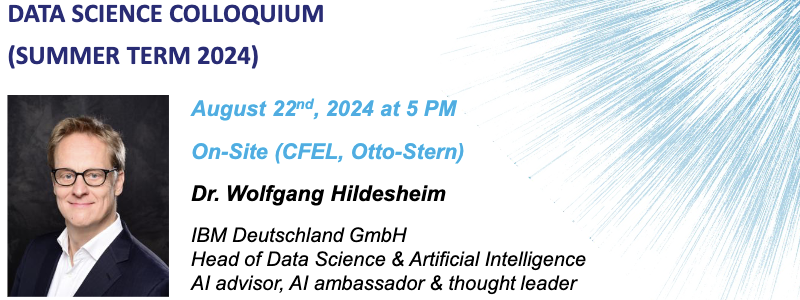
Thursday, August 22th, 2024 | 17:00 p.m.

Data Science Colloquium on August 22nd, 2024 | “AI in Industry | Opportunities and Use Cases”

DESY, Notkestraße 85, Hamburg, Building 99

The Data Science Colloquium is an event jointly organized by DASHH, the Center for Data and Computing in Natural Sciences (CDCS), the clusters of excellence CUI - Advanced Imaging of Matter and Quantum Universe of the Universität Hamburg (UHH), the Department of Informatics of the UHH, the Institute of Mathematics of the Hamburg University of Technology, ahoi.digital - the Alliance of Hamburg Universities for Computer Science and the Wolfgang Pauli Centre.

We are looking forward to the talk of Dr. Wolfgang Hildesheim (IBM Deutschland GmbH, Head of Data Science & Artificial Intelligence, AI advisor, AI ambassador & thought leader) on Thursday, August 22nd, 2024 at 5 pm (on-site). His talk is entitled "AI in Industry | Opportunities and Use Cases". The official announcement and abstract of the talk can be found here.

These events are an ideal opportunity to meet renowned scientists and discuss recent Data Science challenges.

Please subscribe here for news and Zoom links regarding our colloquia or contact dashh-office@desy.de for the individual Zoom link of an online event!


images/02_events/Data%20Science%20Unlocked.png#joomlaImage://local-images/02_events/Data Science Unlocked.png?width=800&height=300
Wednesday, November 12th, 2025 | 11:00 - 12:30 p.m.

Data Science Unlocked: Helmholtz Platforms Roadshow

online

Working with data, code, images, or metadata? Then don’t miss the virtual roadshow hosted by the five Helmholtz Information and Data Science platforms – designed to connect you with the right resources that can elevate your research.

Whether you’re just starting your career or leading your own lab, each platform offers specialized support to meet your needs for free.

What’s in store:

  • Fast-track introductions – Hear a short, dynamic overview of each platform’s focus and strengths.
  • Interactive breakouts – Talk directly with platform representatives and explore tools, resources, and expertise that can boost your research.
Institutions

People

Universität Hamburg
Adeline Scharfenberg
Diese E-Mail-Adresse ist vor Spambots geschützt! Zur Anzeige muss JavaScript eingeschaltet sein. 

Universität Hamburg
Adeline Scharfenberg
Diese E-Mail-Adresse ist vor Spambots geschützt! Zur Anzeige muss JavaScript eingeschaltet sein. 

Universität Hamburg
Adeline Scharfenberg
Diese E-Mail-Adresse ist vor Spambots geschützt! Zur Anzeige muss JavaScript eingeschaltet sein.