LLMs
Events
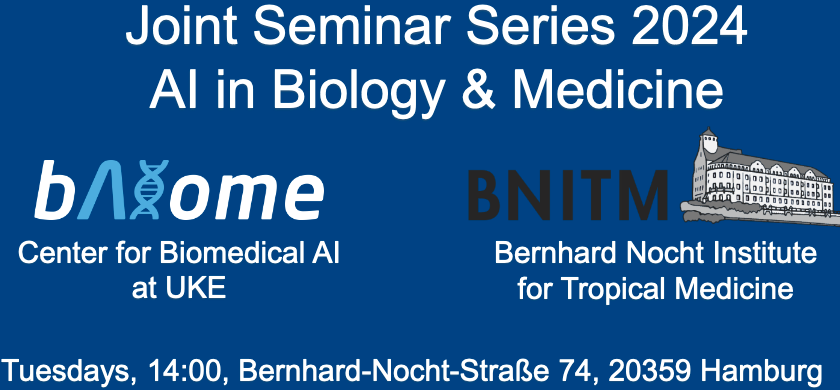
Al for biomedical imaging: computational superresolution and more - BNITM seminar series "AI in Biology and Medicine".
bAIome Center for biomedical AI (UKE) and Bernhard Nocht Institute for Tropical Medicine (BNITM) will host the seminar series entitled “AI in biology and Medicine”. This series aims to capture a broad audience and promote cross institutional collaboration. Our expert speakers will give an overview and insight into particular AI/data science methods being developed in key areas of biology and medicine. We will have drinks and snacks following each seminar to facilitate exchange.
René Werner, Institute for Applied Medical Informatics, UKE
For further details and hybrid links, please go to the webpage AI in Biology & Medicine
Generative AI and magical thinking
Recent advances in Generative AI have given rise to strong emotions among the general public, including excitement, fear, wonder, and disbelief. To be sure, the emergence of Large Language Models (LLMs) marks a significant milestone in the history of AI. But are systems like ChatGPT and Gemini actually intelligent, and are we at the threshold of so-called Artificial General Intelligence (AGI)? This session provides an overview of how LLM-based systems work, where they excel, and where they fall short, with a special emphasis on opportunities for the complementary strengths of humans and machines.
Session Objectives:
By the end of the session, participants will be able to:
- Explain the probabilistic nature of Large Language Models (LLMs) to demystify how they generate responses.
- Differentiate between the capabilities of current Generative AI and the “magical thinking” often associated with Artificial General Intelligence (AGI).
- Identify the operational limitations of AI systems to determine where human intervention and oversight are essential.
- Map complementary strengths of humans and machines to optimize collaboration in their own workflows.
Institutions
- AI for Good
Introduction to Digital Humanities and to the Digital Treatment of Language Data
Are you passionate about exploring the intersection of digital technologies and the humanities? Join our PhD course ‘An Introduction to Digital Humanities and to the digital treatment of language data’ designed specifically for PhD students interested in applying digital methods to their humanities language data, and to thereby be able to answer new kinds of research questions on large amounts of such data. In this course, we will equip you with a basic understanding of various methods, standards, and tools essential for conducting digital humanities research on language data.
Our focus of the course will be on the digital processing of text and speech, exemplified among others through the extensive digital corpora available through The Department of Nordic Studies and Linguistics. You will have hands-on experience with the corpus tool Korp, enabling you to unlock valuable insights hidden within vast amounts of textual data. Additionally, we will look into natural language processing techniques, providing you with a practical introduction to zero-shot & few-shot prompting of large language models, and machine learning with Python. Finally, you will be introduced to modern prompting and RAG (Retrieval Augmented Generation) techniques for having large language models (LLMs) assist in annotating and analysing your material. You will get the opportunity to work with these tools also on your own data.
For more information about the PhD course, please contact the PhD Administration (phd@hrsc.ku.dk).
Institutions
- PhD School at the Faculty of Humanities at University of Copenhagen
Machine learning of MCMV infection dynamics - BNITM seminar series "AI in Biology and Medicine".
bAIome Center for biomedical AI (UKE) and Bernhard Nocht Institute for Tropical Medicine (BNITM) will host the seminar series entitled “AI in biology and Medicine”. This series aims to capture a broad audience and promote cross institutional collaboration. Our expert speakers will give an overview and insight into particular AI/data science methods being developed in key areas of biology and medicine. We will have drinks and snacks following each seminar to facilitate exchange.
Lorenz Adlung, I Medical Clinic and Polyclinic, UKE: Machine learning of MCMV infection dynamics
For further details and hybrid links, please go to the webpage AI in Biology & Medicine

Neuronale Netze und Sprachmodelle verstehen: KI-Grundlagen in 30 Minuten
In 30 Minuten erhalten Sie einen verständlichen Überblick über neuronale Netze und große Sprachmodelle (LLMs) – die heute dominierenden KI-Verfahren. Wir betrachten, wie Maschinen aus Daten lernen, wie einfache neuronale Netze und moderne große Sprachmodelle aufgebaut sind. Anschließend werden gesellschaftliche Chancen (z.B. Produktivität, Barrierefreiheit) und Risiken (z.B. Bias, Halluzinationen, Desinformation, Energieverbrauch, Blackbox) einander gegenübergestellt und mögliche Zukunftsszenarien vorgestellt. Für die Teilnahme werden keine technischen Vorkenntnisse vorausgesetzt.
Als virtuellen Lernort werden wir ZOOM nutzen. Der ZOOM-Link wird einen Tag vor Schulungsbeginn bis 13:00 Uhr versendet.
Institutions
- Multimedia Kontor Hamburg gGmbH
Predicting clinical response to treatment in inpatients with depression - BNITM seminar series "AI in Biology and Medicine".
bAIome Center for biomedical AI (UKE) and Bernhard Nocht Institute for Tropical Medicine (BNITM) will host the seminar series entitled “AI in biology and Medicine”. This series aims to capture a broad audience and promote cross institutional collaboration. Our expert speakers will give an overview and insight into particular AI/data science methods being developed in key areas of biology and medicine. We will have drinks and snacks following each seminar to facilitate exchange.
Fatemeh Hadaeghi,Institute of Computational Neuroscience, UKE
For further details and hybrid links, please go to the webpage AI in Biology & Medicine
Ringvorlesung: »KI in der Hochschule: Perspektiven aus Lehre, Forschung und Praxis
Serendipity Prompting. Wie wir durch LLMs Denkblockaden überwinden und über den eigenen Tellerrand schauen können
mit Dr. Thorsten Dresing, Dipl.Päd., Thorsten Pehl & Prof. Dr. Uwe Krähnke
Generative KI wird häufig als eindimensionale Stichwortgeberin oder finaler Textgenerator genutzt. Bei dem in der Vorlesung vorgestellten Serendipity-Prompting wird diese Praxis umgekehrt: Durch eine spezifische Prompt-Architektur agiert das LLM als mäeutischer Impulsgeber, der die Nutzer:innen im Zuge eines iterativen Dialogs zu einer reflexiven Wissensaneignung herausfordert. An einem konkreten Beispiel aus der qualitativen Forschung wird demonstriert, wie die Nutzer:innen auf Limitationen der eigenen Sichtweise stoßen und zu neuartigen Perspektiven gelangen können. Über weitere Anwendungsmöglichkeiten des Serendipity-Prompting in Forschung und Lehre soll nach der Präsentation gemeinsam diskutiert werden.
Institutions
- MSH Medical School Hamburg
Ringvorlesung: KI-Kompetenz? KI-Chatbot-Didaktik ist der Schlüssel!
KI-Kompetenz? KI-Chatbot-Didaktik ist der Schlüssel! mit Dr. Wolfgang König
KI-Kompetenz wird auch an Hochschulen zur zentralen Zukunftsfähigkeit – doch ihr Erwerb ist kein Selbstläufer. Erst durch gezielte KI-Chatbot-Didaktik lernen Studierende, KI reflektiert, kritisch und produktiv einzusetzen. Wer Lehre neu denkt, erkennt: KI-Chatbot-Didaktik ist der zentrale Schlüssel für eine wirksame Hochschulbildung.
Dr. Wolfgang König ist KI-Experte beim Bildungswerk der Wirtschaft gGmbH und wird u.a. von der LinkedIn-Newsredaktion empfohlen. Er ist Interviewpartner u.a. im Deutschlandfunk und ZDF. In der Erwachsenenbildung ist er für das von ihm entwickelte Graue-Box-Modell der Chatbot-Didaktik bekannt sowie für das KI-Chatbot-Lernframework. Er verantwortet im Netzwerk Q (gefördert vom Bundesministerium für Bildung, Familie, Senioren, Frauen und Jugend) verschiedenen Lernpakete zu KI-Didaktik und KI-Compliance. Seit März 2026 leitet er den Weiterbildungsverbund KI-Kompetenz (Kofinanziert von der Europäischen Union).
Institutions
- MSH Medical School Hamburg
Ringvorlesung: Kittel, Code, VR-Brille: wie intelligent muss KI sein, um in der ärztlichen Ausbildung zu unterstützen?
Kittel, Code, VR-Brille: wie intelligent muss KI sein, um in der ärztlichen Ausbildung zu unterstützen?«
mit Prof. Benjamin Risse
Institutions
- MSH Medical School Hamburg
Ringvorlesung: Menschzentrierte KI-Implementierung in der Praxis: Einblicke aus dem BSP-Drittmittelprojekt Mittelstand-Digital Zentrum Zukunftskultur
Menschzentrierte KI-Implementierung in der Praxis: Einblicke aus dem BSP-Drittmittelprojekt Mittelstand-Digital Zentrum Zukunftskultur«
mit Kristina Bodrozic-Brnic
Anhand konkreter Praxisprojekte zeige ich, wie menschzentrierte KI-Implementierung gelingt – indem Vertrauen aufgebaut, kreative Potenziale aktiviert und KI schrittweise in bestehende Arbeitsprozesse integriert wird.
Institutions
- MSH Medical School Hamburg
Systems Biology of Cancer - BNITM seminar series "AI in Biology and Medicine".
bAIome Center for biomedical AI (UKE) and Bernhard Nocht Institute for Tropical Medicine (BNITM) will host the seminar series entitled “AI in biology and Medicine”. This series aims to capture a broad audience and promote cross institutional collaboration. Our expert speakers will give an overview and insight into particular AI/data science methods being developed in key areas of biology and medicine. We will have drinks and snacks following each seminar to facilitate exchange.
Angela Relógio, Medical School Hamburg MSH
For further details and hybrid links, please go to the webpage AI in Biology & Medicine
Technical foundations of Large Language Models, their applications and limitations - BNITM seminar series "AI in Biology and Medicine".
bAIome Center for biomedical AI (UKE) and Bernhard Nocht Institute for Tropical Medicine (BNITM) will host the seminar series entitled “AI in biology and Medicine”. This series aims to capture a broad audience and promote cross institutional collaboration. Our expert speakers will give an overview and insight into particular AI/data science methods being developed in key areas of biology and medicine. We will have drinks and snacks following each seminar to facilitate exchange.
Christopher Gundler, Institute for Applied Medical Informatics, UKE
For further details and hybrid links, please go to the webpage AI in Biology & Medicine
Unsupervised patient stratification based on omics data - BNITM seminar series "AI in Biology and Medicine".
bAIome Center for biomedical AI (UKE) and Bernhard Nocht Institute for Tropical Medicine (BNITM) will host the seminar series entitled “AI in biology and Medicine”. This series aims to capture a broad audience and promote cross institutional collaboration. Our expert speakers will give an overview and insight into particular AI/data science methods being developed in key areas of biology and medicine. We will have drinks and snacks following each seminar to facilitate exchange.
Olga Zolotareva, Institute for Computational Systems Biology, UHH
For further details and hybrid links, please go to the webpage AI in Biology & Medicine

Universität Hamburg
Adeline Scharfenberg