climate observations
Events

Wednesday, November 5th, 2025 | 17:00 - 18:00 p.m.
Earth on a chip: AI-based autoregressive models of our coupled climate system
online
Recent advances in machine learning have revolutionized dynamical modeling, yet AI weather and climate models often suffer from instability and unphysical drift when integrated over long timescales. This talk unifies three complementary works addressing this challenge. First, we present a theoretical eigenanalysis of neural autoregressive models that establishes a semi-empirical framework linking inference-time stability to the spectrum of the model’s Jacobian. This analysis reveals how integration-constrained architectures suppress unstable eigenmodes and enable predictable error growth. Building on this foundation, we identify spectral bias—a universal tendency of deep networks to under-represent high-wavenumber dynamics—as the root cause of instability in AI weather models. We demonstrate how higher-order integration schemes and spectral regularization, implemented in the FouRKS framework, mitigate this bias and produce century-scale stable emulations of turbulent flows. Finally, we translate these theoretical insights into practice with LUCIE-3D, a data-driven climate emulator trained on reanalysis data that captures forced responses to CO₂, reproduces stratospheric cooling and surface warming, and remains computationally efficient. Together, these results chart a rigorous pathway from mathematical theory to physically consistent AI climate models capable of stable, interpretable, and trustworthy long-term Earth-system emulation.
Institutions
- AI for Good
Monday, November 17th 2025 | 17:00 - 18:00 p.m.
Grounding foundation models for automated climate science
online
Despite the huge success of foundation models across fields, they still suffer from hallucinations and can produce physically inconsistent outputs. To leverage foundation models for climate science, it is critical to integrate first principles and physical laws to the learning and reasoning of these models. In this talk, I will discuss our on-going effort to ground foundation models, including diffusion models and large language models for climate science. In particular, I will discuss dynamics-informed diffusion models for emulating complex fluids and an adaptive framework for LLM agents to use scientific tools. I will demonstrate the use cases of our methods on building an autonomous LLM agent as a climate co-scientist.
Learning Objectives:
By the end of this session, participants will be able to:
- Identify the limitations of current foundation models in climate science.
- Understand how integrating first principles and physical laws can ground diffusion models and LLMs for reliable scientific use.
- Recognize emerging applications of autonomous LLM agents as climate co-scientists for simulation, reasoning, and tool use.
Institutions
- AI for Good
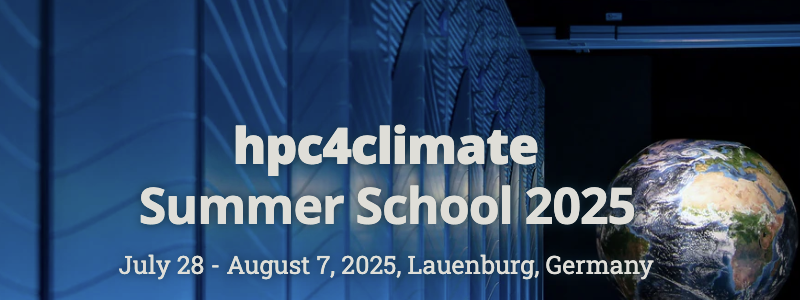
Monday, July 28th - Thursday, August 7th, 2025 | several times
hpc4climate Summer School 2025
Welcome to the 2025 edition of the WarmWorld-ESiWACE3 Summer School, in the old town of Lauenburg near Hamburg!
The Summer School will give an insight into ICON , one of the state-of-the-art weather and climate science models. The students will learn basic meteorology concepts and will be invited to tackle code challenges using intermediate and advanced approaches from software engineering, high-performance computing and data analysis, all under the guidance of experienced lecturers from these various fields.
Important dates
- Apr 15, 2025 – Deadline for travel grants requests
- Apr 30, 2025 – Registration closes
- until May 15, 2025 – Notification of acceptance
- Jul 28 - Aug 7, 2025 – Summer School
Academic Programme:
Invited professors and computational scientists from partner institutions contribute to a 10-day programme of 60+ hours of lectures and hands-on exercises, covering two main themes: climate modelling and modern scientific computing, which span over a variety of topics: here
Institutions
- IT Center for Science (CSC-IT)
- Deutsches Klimarechenzentrum (DKRZ)
- Deutscher Wetterdienst (DWD)
- Technical University of Munich (TUM)
- University of Cologne , Center for Earth System Observation and Computational Analysis (CESOC)
- Max Planck Institute for Meteorology (MPI-M)
Thursday, May 7th, 2026 | 11:00 a.m.
TRR 181 Seminar Series: Using machine learning for regional forecasting and climate downscaling of the atmosphere and ocean - can we throw out our numerical models now?
Bundesstr. 53, Hamburg, room 22/23
Prof. Øyvind Breivik (University of Bergen)
The recent advances in ML or AI modelling of the atmosphere and the ocean have upended decades of conventional wisdom - namely that the way forward is higher resolution and better parameterizations of what remains unresolved. Here I will present a handful of examples of how forecasting and modelling the atmosphere and the ocean can be done using graph neural networks and more traditional convolutional neural networks. The big question is then whether we are headed toward a future where models in the traditional sense become obsolete? I will argue that on the contrary, we need the models to guide (supervise) machine learning and artificial intelligence. However, the current use of numerical models is not fit for purpose and we need to rethink what type of numerical models we use for the training. We also need to be aware of the common pitfalls in machine learning - perhaps most importantly how ML models handle previously "unseen" cases, whether these come in the form of extreme weather events or in modelling a future climate very different from what the models have been trained on.
Institutions
- Earth and Society Research Hub (ESRAH) (UHH)
Wednesday, October 1th, 2025 | 17:00 - 18:00 p.m.
Understanding past climate events and trends to constrain near-future climate risk
online
The global mean surface temperature record combining sea surface and near-surface air data is central to understanding climate variability and change. Understanding the past record also helps constrain uncertainty in future climate projections. In my talk, I will present a recent study (Sippel et al., 2024, Nature, doi:10.1038/s41586-024-08230-1) that refines our view of the historical record and explore its implications for near-future climate risk.
Past temperature record: The early temperature record (before ~1950) remains uncertain due to evolving methods, limited documentation, and sparse coverage. Independent reconstructions show that historical ocean temperatures were likely measured too cold by about 0.26 °C compared to land estimates despite strong agreement in other periods. This cold bias cannot be explained by natural variability; multiple lines of evidence (climate attribution, timescale analysis, coastal data, palaeoclimate records) support a substantial cold bias in early ocean records. While overall warming since the mid-19th century is unchanged, correcting the bias reduces early-20th-century warming trends, lowers global decadal variability, and brings models and observations into closer alignment.
Constraining climate risk: I will close my talk by discussing how these findings sharpen near-future temperature projections and our understanding of climate risk; and furthermore how new AI methods may provide an even clearer picture of past climate and near-future climate risk.
Institutions
- AI for Good

Universität Hamburg
Adeline Scharfenberg