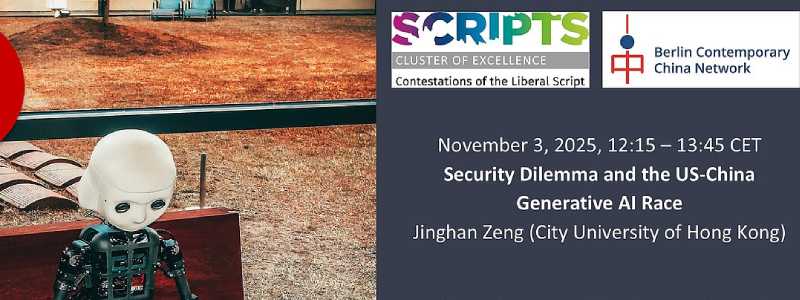
BCCN Lecture Series: AI Governance in China
Eddie Yang (Purdue University): Propaganda is Already Influencing Large Language Models: Evidence from Training Data, Audits, and Real-world Usage
Artificial intelligence is rapidly transforming societies, economies, and political systems worldwide, and China is emerging as a central actor in shaping the governance of these technologies. This lecture series explores the multiple dimensions of AI governance in China, from state regulation and the role of AI in public administration to societal engagement with AI technologies.
The lectures highlight how China’s AI ambitions intersect with broader global trends and geopolitical tensions. The rise of generative AI has intensified the U.S.–China technological and strategic competition, introducing new complexities to the traditional security dilemma. At the same time, Chinese efforts to regulate and promote AI domestically reflect broader concerns over economic competitiveness, social stability, and regime security. The BCCN lecture series shed light on how AI is reshaping power relations, technological competition, and everyday life.
Join us online and in person for six lectures featuring leading scholars, including: Jinghan Zeng (City University of Hong Kong), Hui Zhou and Genia Kostka (Freie Universität Berlin) and Angela Huyue Zhang (USC Gould School of Law), Eddie Yang (Purdue University), David Yang (Harvard University) and Jeffrey Ding (George Washington University).
Hosted by the Berlin Contemporary China Network (BCCN), the China Competence Training Center (CCTC) and SCRIPTS, the 2025/26 winter term lecture series is conceptualized by Prof. Dr. Genia Kostka and Anton Bogs from Freie Universität Berlin.
Institutions
- Institut für Asien- und Afrikawissenschaften, Humboldt-Universität zu Berlin

Universität Hamburg
Adeline Scharfenberg