humanities
Events
AI and the Humanities: Epistemic Challenges Today and Tomorrow
This week's GlobeColloquium explores how artificial intelligence challenges the humanities’ ways of knowing—now and in the near future. PD Dr. Rico Hauswald traces the self-understanding of the humanities and maps phases of AI integration, from assistive tools to increasingly autonomous agents. What does this mean for knowledge production, epistemic authority, and the societal role of the humanities and the sciences? The session is chaired by Marian Burchardt.
This talk explores the epistemic challenges that artificial intelligence poses to the humanities today and in the future. It situates these challenges within the broader intellectual history of reflections on the nature of the humanities as a distinct mode of inquiry, in contrast to both the natural and the social sciences. By developing a typology of different phases of AI integration – ranging from simple AI tools to fully autonomous, independent AI researchers – and relating them to conceptions of the stages of academic inquiry, the talk examines how the production of knowledge in the humanities and the sciences is being transformed. Finally, it discusses the broader implications of these transformations for their societal role and addresses the resulting challenges, from shifting epistemic authority to the potential existential risks posed by increasingly autonomous AI agents.
Rico Hauswald is a scholar of philosophy interested in social epistemology and the philosophy of science and technology, among others. For the last three years he has been PI of the project »VUKIM – Dealing responsibly with AI-assisted systems in medicine – SP-E Epistemological aspects«, funded by the BMBF. His habilitation thesis on “Epistemic Authorities: Individual and Plural” was published in 2024. Hauswald currently holds the position of Interim Professor for Theoretical Philosophy at TU Dresden.
Institutions
- Universität Leipzig
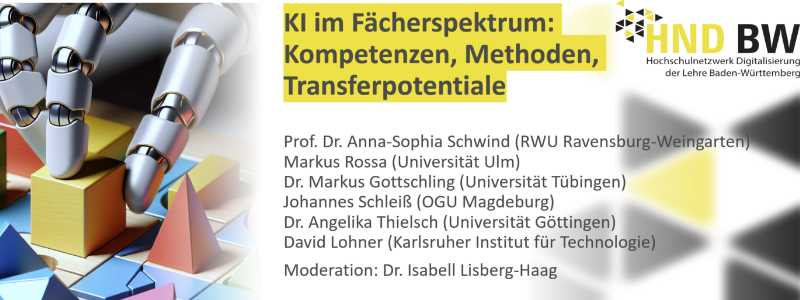
KI im Fächerspektrum: Kompetenzen, Methoden, Transferpotentiale
Im Fokus der Veranstaltung stehen die besonderen Anforderungen einzelner Disziplinen und Fächer an den Einsatz von KI in der Lehre sowie die Entwicklung fachspezifischer KI-Kompetenzen. Impulsvorträge aus den Sozial-, Ingenieur- und Geisteswissenschaften beleuchten Einsatzmöglichkeiten von KI im jeweiligen Studienbereich, diskutieren fachspezifisch relevante KI-Kompetenzen und zeigen konkrete Anwendungsbeispiele auf.
Prof. Dr. Anna-Sophia Schwind (RWU Ravensburg-Weingarten) & Markus Rossa (Universität Ulm) stellen einen Ansatz zur Integration von VR und KI in der psychologischen Gesprächsführung vor. Johannes Schleiß (Otto-von-Guericke-Universität Magdeburg) diskutiert KI-Kompetenzen in den Ingenieur-wissenschaften. Dr. Markus Gottschling (Universität Tübingen) reflektiert Lehrerfahrungen und Forschungsergebnisse zum Einsatz von KI in der Literaturwissenschaft und Rhetorik.
In der anschließenden Podiumsdiskussion diskutieren die Referent*innen mit Dr. Angelika Thielsch (Universität Göttingen) und David Lohner (Karlsruher Institut für Technologie) über interdisziplinäre Transferpotenziale und Herausforderungen im Umgang mit KI in der Hochschullehre. Die Veranstaltung wird moderiert von Dr. Isabell Lisberg-Haag.
Die Veranstaltung bietet allen Interessierten die Möglichkeit, sich über aktuelle Forschungsergebnisse zum Umgang mit KI in einzelnen Studienbereichen zu informieren, von Good-Practices aus verschiedenen Fachdisziplinen zu lernen sowie sich mit Expert*innen auszutauschen und neue Kontakte zu knüpfen
Die Teilnahme ist kostenfrei. Eine Anmeldung bis 24.01.2025 ist erforderlich.
Institution
- Multimedia Kontor Hamburg gGmbH
- Hochschulnetzwerk Digitalisierung der Lehre Baden-Württemberg (HND-BW)
- ELAN e.V.
- Virtuelle Hochschule Bayern (vhb)
- VCRP
Institutions
Centre for the Study of Manuscript Cultures (CSMC), UHH
The centre brings together an international and cross-disciplinary research community to study written artefacts

Universität Hamburg
Adeline Scharfenberg